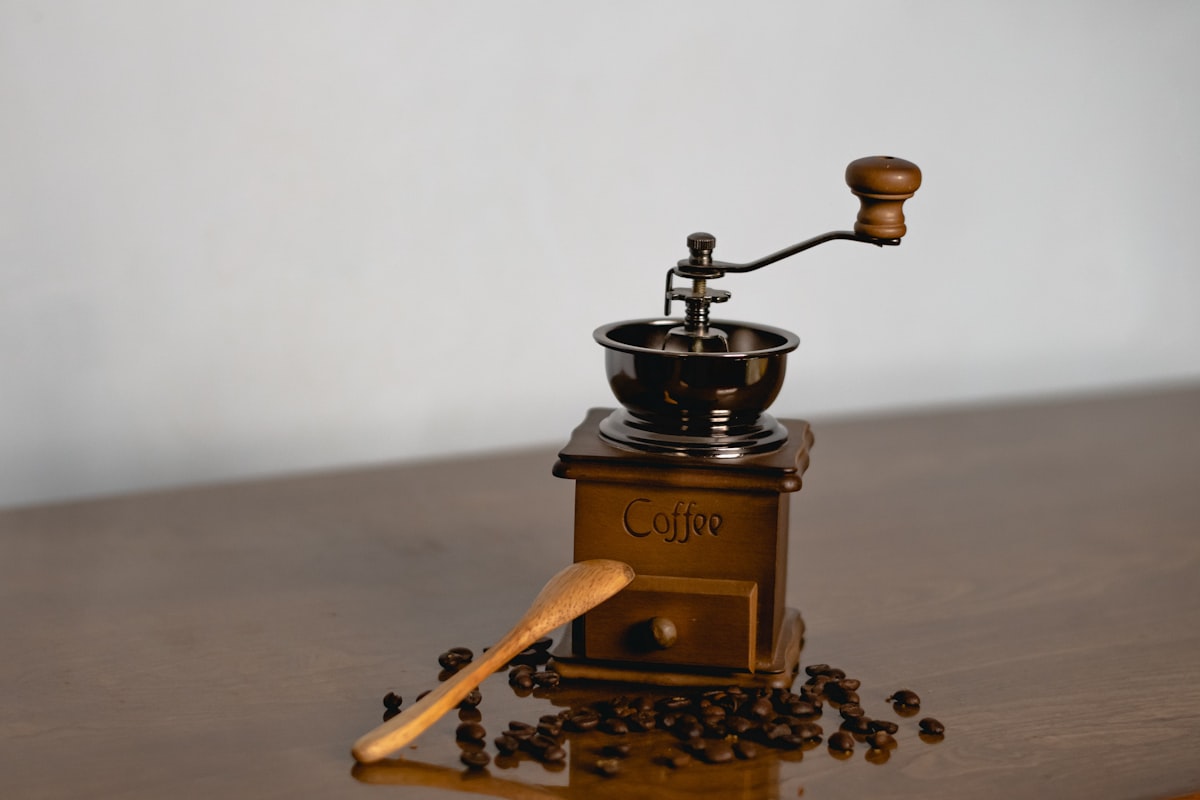
Coffee grinder discussions online have a tendency to escalate quickly into talk of retention, bimodal distribution, and particle size distribution curves. This is not wrong, exactly — these things do matter if you care about them. But if you are trying to decide whether to spend money on a grinder and which one to buy, most of that conversation skips over the more basic questions.
The most basic question is: what kind of coffee do you make?
Burr versus blade
A blade grinder chops the beans. The result is an uneven mix of coarse and fine particles. Extraction is uneven because the fine particles over-extract while the coarse ones under-extract. The coffee tastes muddled as a result — often both bitter and sour at once, in a way that is hard to fix by adjusting anything else.
A burr grinder crushes the beans between two surfaces with controlled spacing. The result is more consistent particle size. More consistent grinding makes it much easier to get consistent, adjustable extraction.
If you are making filter coffee in a drip machine and you are not particularly interested in what the result tastes like, a blade grinder may be fine. If you want to make adjustments to improve flavour — whether in filter, pour-over, or espresso — a burr grinder is a necessary starting point, not an upgrade.
Conical versus flat burrs
Within burr grinders, the common distinction is between conical burrs (one cone inside a ring) and flat burrs (two parallel rings). Both produce usable results. The differences are real but often exaggerated in consumer-facing writing.
Conical burrs tend to retain less ground coffee in the grinder after use. This matters more if you switch between beans frequently or grind small doses. They also tend to be quieter.
Flat burrs produce a more symmetrical grind particle size distribution, which some people find easier to dial in for espresso. They also tend to run faster and generate more heat, which in theory affects flavour at very high volumes.
For home use making fewer than fifteen to twenty espressos a day, the practical difference between decent conical and flat burr grinders is smaller than most online discussion suggests.
Espresso versus filter: different requirements
This is the most important distinction for purchasing, and it is the one most often glossed over.
Espresso requires very fine, consistent grinding with precise stepless adjustment. Espresso grinders need to hold their calibration reliably across uses and respond predictably to small adjustments. A grinder recommended primarily for filter coffee will often be unable to grind fine enough for espresso, and may have too coarse an adjustment range to dial in properly.
Filter coffee — pour-over, French press, batch brew — requires coarser grinding and is more forgiving of slight inconsistencies in grind size. A good filter grinder can often produce decent results across different filter methods without major adjustment.
Grinders marketed as both espresso and filter-capable are common. Some are genuinely versatile. Some are mediocre at both. The key question is whether reviewers who actually use it for espresso report being able to dial it in at fine settings.
Hand grinders
Manual hand grinders deserve a mention because they are often ignored at the mid-range price point. A hand grinder at the same price as an entry-level electric grinder often produces more consistent grounds. The trade-off is time — grinding enough for a pour-over takes about sixty to ninety seconds of hand cranking, depending on the model and dose.
For one or two cups in the morning and a tolerance for the process, hand grinders are a reasonable choice at lower budgets. For more than one person or more than two cups, electric becomes significantly more practical.
Noise
Electric grinders are loud. The noise varies considerably between models, but even quiet ones are above 70 decibels. If you share a home with someone on a different schedule, this is worth thinking about. Conical burr grinders are generally quieter than flat burr grinders. Hand grinders are quieter than either.
The short version
Decide whether you are making espresso or filter. For espresso: the grinder needs stepless or very fine stepped adjustment and reviewers should confirm it works at fine settings. For filter: requirements are less strict, but burr remains strongly preferable to blade.
If budget is limited: a hand grinder at the same budget often outperforms an entry-level electric on grind consistency for filter brewing.
The conical-versus-flat debate matters more at the high end than the mid-range. Both work.